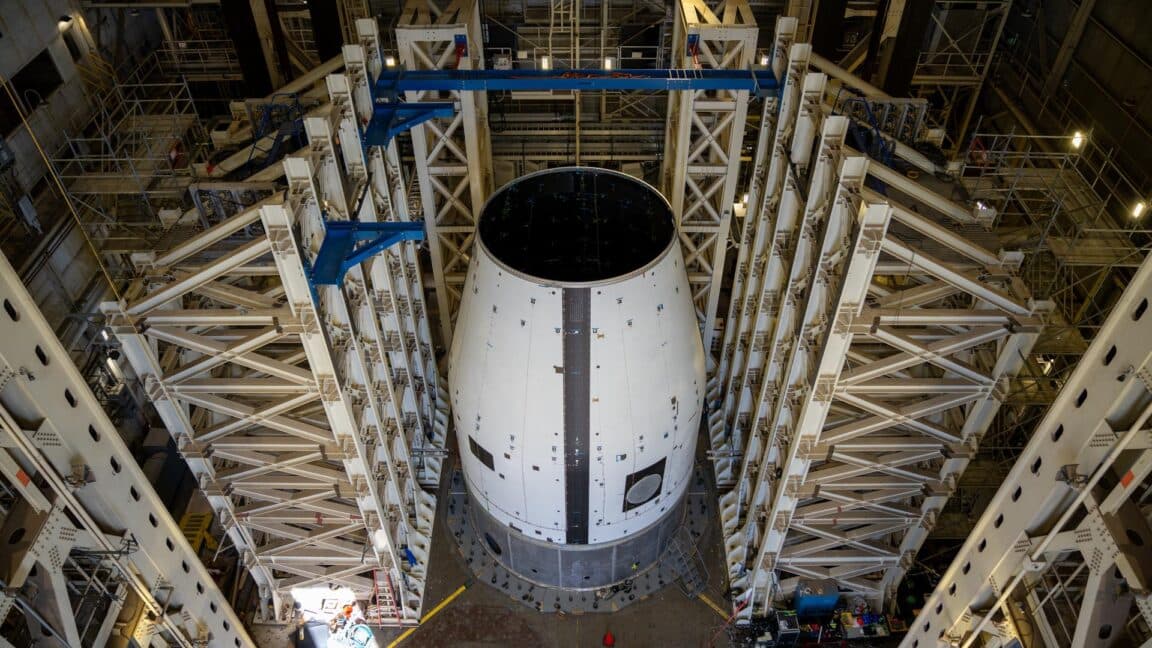
$500 Million for a Tube
NASA's Inspector General (IG) released a memorandum that validates the agency's decision to cancel several Artemis contracts earlier this year. The report focuses on four contracts totaling $5.9 billion, up from an original $2.8 billion. The most egregious example: the Universal Stage Adapter (USA).
Dynetics won the USA contract in June 2017 for $131 million. The adapter is a 33-foot-tall, 9,650-pound composite structure that connects the upper stage of the Space Launch System to the Orion spacecraft. It has no propulsion, no electronics—just a structural tube with a payload separation system.
NASA added $9 million for that separation system later. By the time the program was canceled earlier this year, the contract value had grown to $353 million. The IG projected the final cost would hit $497 million, with delivery slipping to May 2030. That's 13 years from contract award for a piece of hardware that could be designed and built by a small team in under two years.
A Pattern of Failure
The USA contract is the least expensive of the four. The report also covers:
- Habitation and Logistics Outpost (HALO): Part of the Lunar Gateway, this module was contracted to Northrop Grumman. It was running years late, and the IG estimated the Gateway wouldn't be operational until at least 2032. NASA formally asked Northrop to stop work last week.
- Two other contracts for exploration systems saw similar cost growth and schedule slips.
Lori Glaze, chief of NASA's Human Spaceflight Directorate, wrote in response: "The challenges summarized in the memorandum—cost growth, schedule slips, contractor performance issues, and evolving mission requirements—reinforce the rationale behind the decisions."
Why This Matters for Developers
Yes, this is aerospace, not software. But the patterns are identical to what happens in large-scale software projects:
- Fixed-price contracts with vague requirements. Dynetics bid $131 million, but NASA kept adding scope (payload separation system) without adjusting the timeline.
- No incremental delivery. The adapter was built as a monolithic waterfall project. No prototypes, no iterative testing, no early demos.
- No accountability for schedule slips. The contract allowed years of delays without penalty. The IG report notes that the project was already 7 years late when it was canceled.
Compare this to how SpaceX builds hardware: they iterate rapidly, test early, and accept failures. The Falcon 9's interstage (a similar structural adapter) was developed in months, not years.
The Numbers
| Contract | Original Value | Final Cost (est.) | Delay |
|---|---|---|---|
| Universal Stage Adapter | $131M | $497M | 13 years |
| HALO (Gateway module) | undisclosed | undisclosed | ~10 years |
| All four contracts | $2.8B | $5.9B | 5-13 years each |
What Developers Should Learn
- Never accept a multi-year waterfall schedule. Break the work into 2-week sprints with demonstrable outcomes.
- Beware of scope creep without timeline adjustments. Every new feature should push the deadline.
- Build prototypes early. A 33-foot composite tube is not rocket science. A small team with carbon fiber expertise could build one in 6 months.
The IG report is a textbook case of how not to manage a technical project. The same lessons apply whether you're building a rocket adapter or a microservice.
Next Steps
Read the full IG memorandum (available on NASA's OIG website) for the complete breakdown of each contract. If you're a contractor working with NASA or any large organization, use this as ammunition to push for agile contracts.
And if you ever hear "it's just a stage adapter, how hard can it be?"—remember: $500 million and 13 years.