The Bear Case Against Dashboards
Radar builds a Kubernetes dashboard. This post argues against their own product—because if the argument holds, they'd rather hear it from themselves than a competitor.
The bear case: For years, you opened a dashboard because a cluster holds too much state to keep in your head. An agent doesn't need to look—it reads structured data, reasons over it, and acts. If the agent operates, the dashboard becomes a horse in 1910: still useful, but clearly on the wrong side of the trend. Every operations hour that moves to an agent is an hour nobody spends in the UI.
Satya Nadella said in late 2024 that business applications "will all collapse in the Agent Era." Andrej Karpathy framed agents as a third consumer of software—one that doesn't want a GUI. Radar's own benchmark: an agent reasoning over structured cluster data diagnosed better with a quarter of the tool calls compared to raw kubectl on 52 cluster faults.
Klarna's announcement that it would drop Salesforce and Workday because AI would replace them made headlines. The quieter follow-up: the products went, but the work didn't dissolve into a chat window—it got rebuilt across internal systems, and the CEO walked back how much AI could actually run on its own.
What Actually Dies
Some dashboard features are going away:
- The resource browser as a daily workflow is dying.
- Click-ops—navigating four screens to restart a Deployment—is dying and deserves to.
- Static dashboards you keep open because you might miss something are dying fastest.
Charity Majors (observability co-founder) called this in 2021: every dashboard is an answer to a question you've since forgotten. Staring at one waiting for trouble is pattern-matching, not debugging. She distinguished static dashboards from interfaces you can interrogate—that distinction matters.
What the Agent Companies Actually Ship
The teams furthest ahead on operational AI agents don't ship a chat box and stop. Datadog's incident agent resolves an incident by rendering an investigation page: each hypothesis marked validated or ruled out, root cause with evidence, citations you can click. That's not a transcript—it's a dashboard built so a human can verify the agent at a glance.
OpenAI extended the Model Context Protocol so agents can draw interactive interfaces inside the chat. When the people building agents keep building visual surfaces on top, that's not coincidence. It's evidence about the other end of the loop: nobody has figured out how to get a human to trust an agent's work without showing it.
Three Things That Don't Go Anywhere
1. Eyes are parallel, transcripts are serial.
A red cell in a field of green pops out in under a quarter second—your visual system checks the whole field at once. A chat transcript is one token after another, requiring you to assemble the picture. Models also miss or underweight buried information in long inputs—well-built agents query for relevant slices, but that concedes that structure and selection aimed at eyes is just a dashboard.
2. At 3am you arrive cold.
Once agents handle routine cases, the incidents that page a human are the weird ones. You need situational awareness fast—a topology graph with blast radius lit up, a timeline of changes, health rolled up across the fleet. A transcript gives raw perception and makes you assemble meaning under pressure. No paragraph rebuilds understanding as fast as the right picture.
3. Trust has to render somewhere.
The bear case assumes the hard part is doing the work. The hard part is trusting the work was done right. Grafana's observability survey: 19 in 20 practitioners said it matters for AI to show its reasoning. An approval gate must show exactly what will change as a diff—you can check a diff in seconds but not a paragraph. Verification at a glance is precisely what a visual interface does.
The Inversion
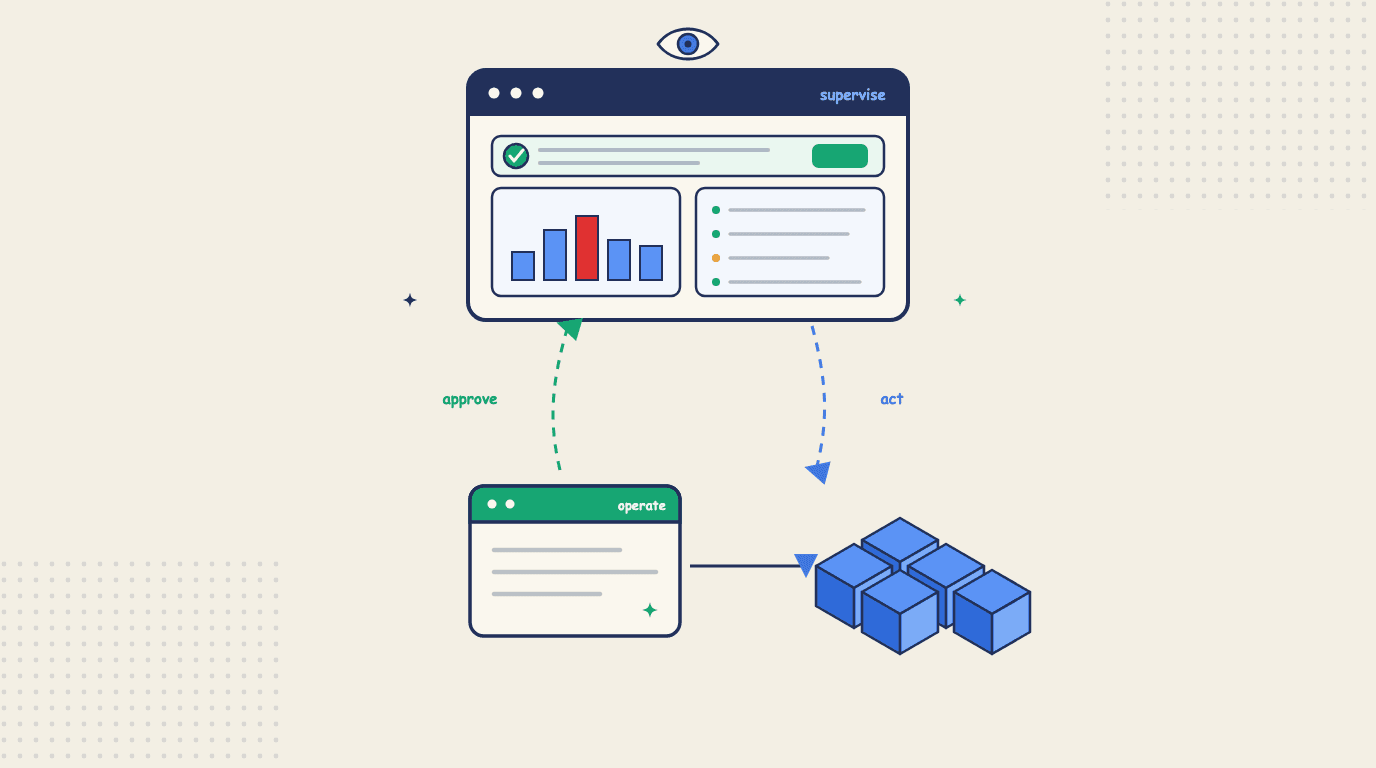
The dashboard doesn't die—its job flips. From cockpit (flying) to control tower (supervising). The valuable surfaces become:
- Approval queue: see what the agent wants to do, wave it through or stop it.
- Action audit trail: what it did and under whose name.
- Agent inventory: button to cut one off.
- Replay of what the agent saw and path it took.
- Evidence view: root cause laid out so you can check.
Concrete example: An agent notices a rollout pushed error rates up and proposes reverting. The surface you want shows affected services lit up on topology, deploy and error curve on same timeline, evidence ruling out database, exact diff the revert will apply, identity it will run under. You can approve in seconds or catch a wrong assumption. A chat message "I found the issue and I can fix it" asks for the same click with none of the checkability.
The Unanswered Question
Where does all this render? Maybe supervision surfaces don't ship as a fixed product—an agent composes the right view on demand, or the approval gate lives in your incident channel, or the evidence view opens inside your editor. OpenAI and Anthropic are betting on generative UI. If that happens, the destination dashboard—the tab you keep open—shrinks.
But the need for a visual surface to supervise agents isn't going away. The dashboard flips from the cockpit you fly to the tower you watch from. That's the future.

